B2B prospects *need* pricing

Did you know that product info is the second thing prospects are looking for?

Dale Underwood of EchoQuote takes a MarketingSherpa/Enquiro report on needs of B2B shoppers and builds up an impressive article about why prospects need pricing. You can read Product Content is #2 for B2B Buyers yourself.

Key takeaway:
Website visitors need pricing MORE THAN they need product information.

In a way it makes sense. B2B prospects basically know what your product is by the time the get to your website. They need to know if they can afford it. Are they on the right trail before they invest more of their valuable time?

Reminds me of a classic Dilbert cartoon I used on this blog when I wrote about pricing in 2007:

Email marketing a high priority? Really?

There was a day when I thought I was a progressive, internet-savvy industrial marketer.  Still today, among B2B marketers willing to fill out an online survey, I’d like to think I’m ahead of the curve.

But apparently the rest of the industrial/B2B marketers have moved on and decided that email marketing is the most important type of marketing they’ll be doing in 2011.

I was stunned to see blogger Chris Rand’s BMON’s response from 183 marketers “Where are you advertising next year?” survey:

What do we find? Firstly, there’s a clear winner. Email marketing is going to be the most important area of investment for industrial and scientific companies next year. Over 80% said it was going to be “high” or “medium” priority, and only 3% said they wouldn’t be using it at all.

I’ve got one niche mailing list I use a couple times a year, and email blasts culled from my CRM for the few shows we do. I don’t even count those as enough to get me out of the lowly 3%, let alone the bottom 20%.

I’ve always put us scientific/industrial/capital-equipment types as ‘demand driven’ marketing. Email should be a lower priority, while optimizing being ‘found’ would be the top goal.

All I’m going to do with email marketing is annoy the very same engineers who will sooner or later be shopping for our type of equipment. They remember what salespeople and companies annoy them. Trust me on this!

Both extremes:

I’ve seen the rise of ‘marketing automation’, and been confused by it all. But for certain marketers (technology/software marketers especially) where nurturing, educating, and creating demand are key tasks, I’m sure it makes sense. Slickly done, with a dedicated staffer running the program, it has to easily show value.

Then there are the really lame email blasts I get from companies that are going to try email marketing about once, half-heartedly. The messages are so bad, no one responds, and email marketing is declared a waste.

Somehow, I suspect there are a lot more than 3% of marketers who fall in the ‘really lame’ category. They certainly aren’t thoughtful enough to read a blog or respond to a survey, though.

Note: I hate surveys because benchmarks don’t always apply to what is right for me. This is certainly the case. But I’m just surprised to be so far in the minority!

Stupid agency mailer FAIL

For those agency people who want to feel smarter than their competition … but mainly as a warning to marketers about the quality that agencies can put out.

Here from my mail is a really pathetic postcard mailer.

"and action!"
"Set the scene!"

Lunch is on us via a gift card? If I’m coming for a tour (a 150 mile drive), why not take me out to lunch?

Lots of other FAIL here. Feel free to add your observations in the comments.

Turn off AdWords?! What I learned…

As I started this blog eight years ago, I wanted to discuss my fear of online advertising. Why the fear:

  • It would be addictive … my success would depend on others, and thus
  • I would give away the power of my own website … my content (my product info) would be used by others for profit and control.

I’ve been able to cut-back or eliminate some advertising sources over the years, but the very obvious power of AdWords had me under its control.

Would I ever be able to shake AdWords? Was I paying for traffic and conversions I would get otherwise? Thankfully, my boss never asked these questions. But I always wondered.

Turn OFF AdWords?

This fall, faced with a very strong sales forecast and production capacity issues (what recession?!), I knew I could turn off AdWords. Sweaty palms when I did it.

That was three months ago. Today I turned AdWords back on.

I got my answers!

I just finished looking at website traffic and sales quote activity during that AdWord-less period (on a week-by-week basis), compared to the previous period. There were two key questions in my mind that were answered:

Did I lose prospects, or did they find us anyway?

  • My conversions dropped by almost exactly the same amount as AdWords had delivered previously. So the prospects whose clicks I didn’t pay for did not ‘find my site’ anyway. Other data confirmed this conclusion.

Did AdWords generate additional traffic?

  • AdWords appeared to generate two quotes for every one conversion. Now sometimes we make two different quotes for prospects, but not at this ratio. I attribute the extra to call-ins or direct emails to reps by these premium prospects. (i.e. the real-world total conversion rate of AdWords clicks is double what your Analytics says it is.)

I hope you appreciate these real-life statistics. I don’t think I’m giving away any real secrets. The one advantage of starting with AdWords so early is that I am used to paying the premium this additional traffic costs. And now I know I’m not an addicted fool, but a smart Marketing Manager!

A competitor across the aisle

We just did our last show for the year. This one is always a great show because our customers are there, and nearly everyone else is a prospect (or knows the person at their company who should be). And all our competitors are there, too.

This year, our main competitor was kitty-corner across the aisle from us. Intimidating to be sure. We’ve got to do better then them somehow, right? We’ve got to bring our A-game. Well, duh, we need to bring our A-game to a show regardless.

And what happened after a little while, is that we worked the show like we normally would, and so did they. Its hard to put on pretenses when you have visitors to interact with…they suddenly are our number-one focus.

So what did I get out of the experience?

  • Our salespeople working the booth are now a little more aware of the dynamics between our companies.
  • An opportunity to see how prospects behave differently when talking to us versus them.
  • We learned a bit more about our competitor’s sales-style based on their behavior in the show booth (showing vs. listening).
  • A chance to see what they know about our company, products, and people.

We had a couple mid-aisle conversations about the show, players in the industry, and other small talk. We see each other once a year, and I did learn I am pretty invisible to them (“are you from the home-office?”).

It was interesting when Peter, a former sales rep of ours, walked one of the competitors over to our booth and proceeded to point out the differences in our products. Then they walked back across the aisle. I kept silent.

Interesting, but who cares? He’s not going to copy what we do. If he didn’t know the details of our product by now, obviously he doesn’t care about it too much. Or, more likely, he doesn’t realize his own weaknesses.

Okay, I will admit wanting to do a close walk-around his product. But I had no reason to, either. We compete so directly, the biggest differences are not the products. Its the branding … and the people who represent the brand. And I think those differences came in to clearer focus for me after this show.

Be smart about your Binghoo PPC settings

I humbled myself and showed you how Yahoo ripped me off with a Search Network of shill websites (See OMG, Yahoo Search PPC is a rip-off.

Now my paused Yahoo Marketing Solutions account has been moved/merged with my (active) Microsoft AdCenter account. Everyone is calling it Binghoo. Guess who’s billings jumped immediately?

(In case you are wondering, 3,600 impressions in the last week, 112 clicks and zero conversions. Apparently the crooks haven’t figured out how to fake conversions with AdCenter ads yet.)

Rather than shut off my AdCenter, I found a pretty easy setting to change on my account. Look for this box under General Settings and select “Only Bing and Yahoo! websites”.

Set your AdCenter settings like this.

Avoid those ‘syndicated search partners’ like the plague!

I’ll be watching closely the rest of the month to make sure this is effective, but it sounds like it should be.

Is this the best B2B website in 2010?

My company website needs a refresher. The home-page is functional almost to a fault.

I found a couple good examples of consumer websites (Subaru & REI) that had layouts that could work for us. And lots of style cues to consider. So what could be more fun than a redesign with a neat jquery ‘slider’ effect on the home page? Very 2010, I think, while still being functional!

Best practices?

Then I googled for best current B2B examples and found the WebAwards B2B winner for 2010. Take a look at the winner, Airclic.com. Go ahead.

There is a lot to like, style-wise. Sliders with bold ‘purpose statements’, lots of white space.  Navigation by industry application.

But what the heck do they do? What business are they in?

They missed one of Vincent Flanders’ red flags: “It takes longer than four seconds for the man from Mars to understand what our site is about.”

Worse yet, the website is full of text with precious little images or effort to engage the visitor. And where the heck is a picture of the product on the home page (let alone any SEO terms).

Beauty before strategy

What we have here is an agency that did its job. And a company with enough sense to get a cool-looking website. But who forgot the content? Who forgot the STRATEGY?

Their Staples customer profile video on the website is 10 times … no … 100 times more effective in telling what they do and making their technology look cool. It should be up front on the home page instead of that cool ‘slider’ thingy with the truck and traffic light. (And proof how video can tell the real truth about a company so much more effectively.)

You’re a manager: get pushed, be pushy!

Handing off your website to an agency doesn’t mean you don’t have to do any work. Expect them to push you with questions. “What is your number one strength?” “We need some images to go with that copy, please.”

Push them with appropriate questions, too. “Why a picture of a truck and not our product?” “I can’t read that ribbon thingy at an angle on the corner of the slider.” “My mom still has no idea what I do at work after seeing this website.”

Maybe I’m being too harsh. It is a new website, and there certainly is some break-in time. Regardless, there is quite a bit of work left to be done. You know your story best, make sure it gets told.

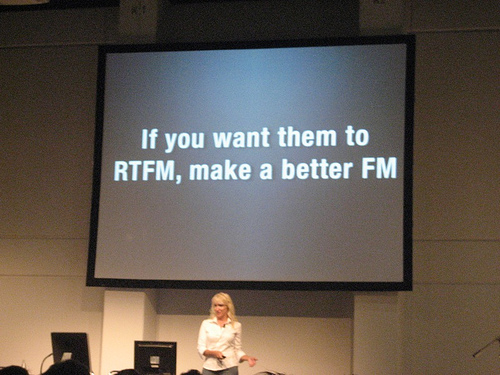
RTFM: Is this the solution?

Had a discussion yesterday and my brain kept flipping back to this picture:

Kathy Sierra says
Kathy Sierra says: "If you want to them to RTFM, make a better FM"

So how do we deal with lazy customers who won’t RTFM? Make a better FM? Really

Two cliches I think apply to this:

  1. Doing things RIGHT is not the same as doing things BETTER.
  2. GOOD is the opposite of GREAT. (Paraphrasing Seth Godin I believe.)

So how much BETTER does the FM need to be? Or should we just skip the FM and do something different (and potentially GREAT)? Or is that too out of the box?

I’ve painted myself into a corner with two of my favorite marketing gurus. They have both written about learning curves for users. But how should we get our customers down the curve?

What do you think? What’s worked for you?

Imagine posting this on your home page

We are currently targeting the solar panel industry, so I’ve subscribed to a number of newsletters about the industry. One today had a press-release about attempts to sell knock offs. Check out what the manufacturer (from Italy) had on their home page:

Not something you see in every-day B2B communications, is it?

My suspicion is that solar panels are pretty generic looking, and it would be easy to stick a brand-name label on a (dare I say) Chinese-made panel.

This was a bold and necessary step by the manufacturer, but I suspect this is not the end of their troubles. How would you handle this? How would you keep it from happening?

Our parent company overseas deals with a number of copy-cat competitors with similar styling, but it is clear the brand is different. One thing they did ‘just in case’ was select a very unique color for our products.

Is industrial marketing this boring?

The magazine for every B2B Marketer

BtoB Magazine has its hands full, trying to offer content for different types of B2B marketers: Agencies, technology companies, big companies, small companies.

The August 16 issue has a two-page feature on ‘manufacturing marketing’ with three articles and a list of manufacturing trade pubs. (Barely a feature, but it did pull a full-page ad from Penton Media, see it below.)

Okay, I thought, this is my vertical … let’s see what the latest and greatest is.

Marketing like it’s 2002.

The articles all talk about online marketing like its something new. Here are the articles and a taste of what they had to say, and my reaction:

Online proves its ROI mettle: This main article talks about resumption of web initiatives by manufacturers as the economy improves. Sample point: “Manufacturing marketers are moving online because Web advertising and search engine marketing are much more measurable.”
Dave says: MEASURABLE? We know that! How about the web is way more functional for B2B marketing.

Outlook improving for manufacturing A two question interview with GlobalSpec’s Marketing Maven based on their benchmarking surveys. Interview response: “Budgets are shifting online: 47% [of respondents] are spending more than one-third of their marketing budget online.”
Dave says: BUDGETS SHIFTING? That ended eight years ago, IMHO. (Okay, the next article proves me wrong, but hey …)

On Site Gas manufactures leads with Web effort
A case study from an agency that helped move a $150K marketing budget to online and overcome lead-management issues. Marketing tactic: “Search marketing efforts included country-specific pay-per-click campaigns as well as an aggressive organic program.”
Dave says: PPC AND SEO? Playing catch-up with the competition?

I shouldn’t be so cynical

So manufacturers are increasingly relying on online marketing tactics? That’s been going on for a decade. I admit we still have a long way to go in improving and maximizing the value of the internet. But we have all committed to online marketing at some level, which makes these articles sound patronizing, thus my reaction.

Like we do any better with print…

Bonus: I also received BtoB’s annual reader survey that highlights a few ads for our opinions. This year was no, different … they were mediocre at best. (See my 2006 comments.)
(Hover for my snark, click for a closer look.)